Our Short Line Railroads

It all began in 1984…
(last updated in 2026)
Since 1984, the North Shore Railroad Company & Affiliates (NSHR) has existed to preserve and foster rail freight service to businesses in Central Pennsylvania. During that time, NSHR has worked to further economic development efforts of the counties they serve through retention, improvement, and expansion of the rail service.
Annually, NSHR spends $12 Million on goods and services in Pennsylvania (almost $9 Million being spent in counties served by NSHR).
More than 200 individuals are directly impacted by NSHR operations (being employees and employee dependents). Further, NSHR’s service impacts 27,500 individuals (being 12,000 employees and their dependents).
Over the past decade, NSHR has spent $60 Million on maintenance and capital upgrades to the rail system it operates over.
NSHR was not always the well-known and accoladed short line railroad company that it is today. Most success stories come from humble beginnings. NSHR’s is no exception.
A Vision from Dick Robey
Richard “Dick” Robey loved and was fascinated by railroading and the rest is history.
Dick was working for a company that was leasing railcars to customers and was going out of business. It was through the railcar leasing in the rail industry that led him to the knowledge about an opportunity in Central PA. Two associates of Dick’s, Mr. Sanders and Mr. Shepstone, told him about a Request for Proposals (RFP) being sought by the SEDA-COG Joint Rail Authority, and he felt that he could make a positive impact. This venture was promised to be uncertain, challenging, and unpredictable.
Robey had no funds; he had zero capital. He would need a line of credit. The tables were turning as he would now need help with leasing equipment - locomotives. People Dick knew in the industry stepped up to help him get established. He had backing from Thomas Philip “Phil “Stout - co-founder (with his father) of Atlas Railroad Construction Company.
Dick founded NSHR with his wife, Miriam “Mimi” Robey. They were the successful proposer of the 1983 RFP, and they quickly mobilized to build a company that made history.
1983 RFP for Rail Operations in Central PA
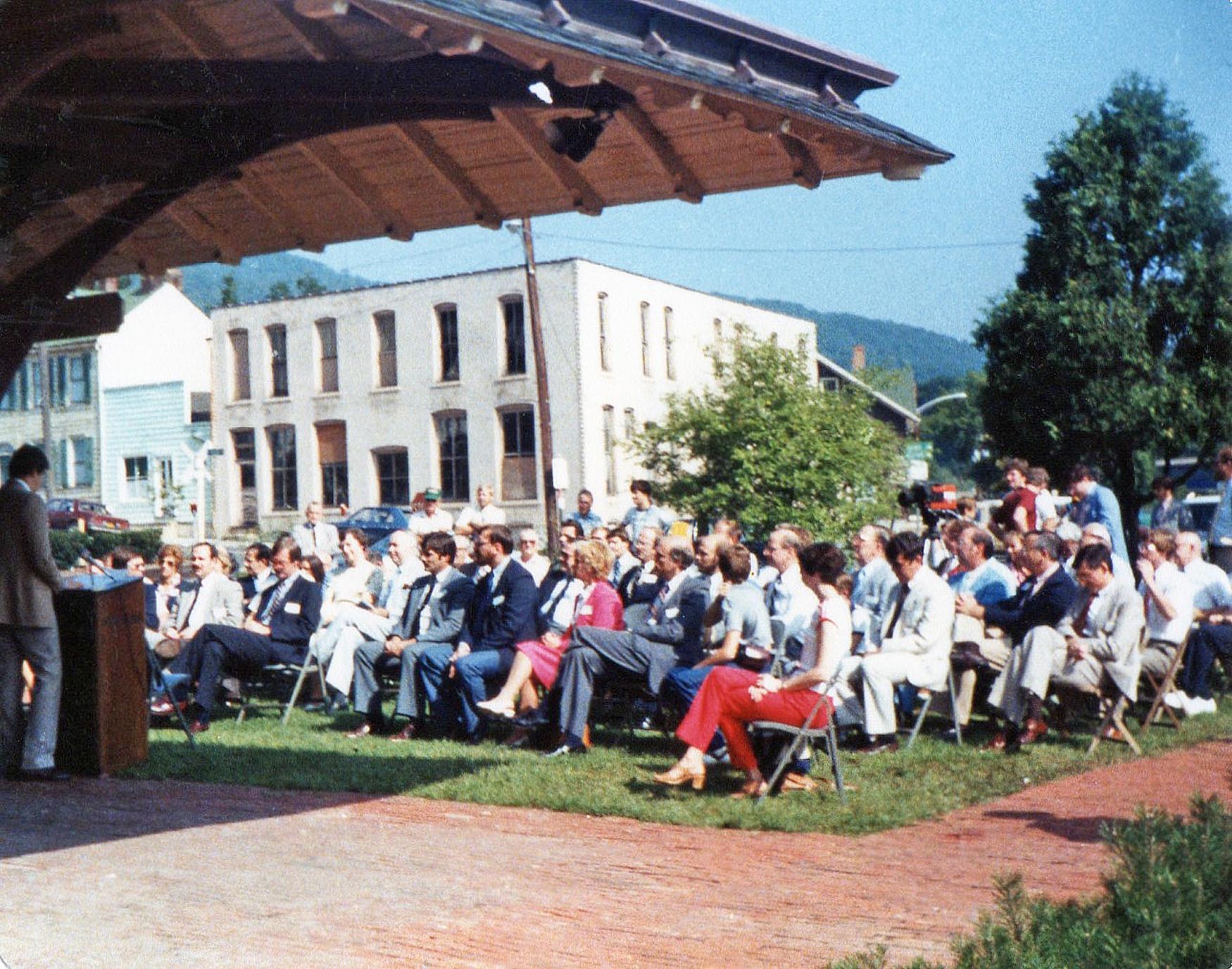
The SEDA-COG Joint Rail Authority was formed in July 1983, through the SEDA Council of Governments Board of Directors to pursue a strategy resulting in the public ownership of rail lines which Conrail had decided to abandon. A municipal authority was formed to manage the railroads of seven different counties: Centre, Clinton, Columbia, Lycoming, Montour, Northumberland, and Union. In the state of Pennsylvania, a municipal authority is not legally permitted to compete with private industries, so they needed to contract with a private operator for this very specialized service. Dick Robey was the prevailing candidate of their RFP.
The first railroads under this public-private partnership were the North Shore Railroad and the Nittany & Bald Eagle Railroad. They provided service to 22 industries that provided 3,000 jobs.
The North Shore Railroad serves customers from Northumberland to Berwick, PA. (In 2022, NSHR began serving customers from Selinsgrove to Kreamer and Shamokin Dam, PA.) Today, North Shore Railroad is a 49.8 mile short line that interchanges with Norfolk Southern and Canadian Pacific Railway (via NS Haulage) in Northumberland, PA. NSHR handles commodities that vary from grains and plastics to scrap metals and concrete vaults. The NSHR line parallels the North Branch of the Susquehanna River and the old North Branch Canal. The line was originally built by Lackawanna & Bloomsburg Railroad (L&B), incorporated in 1852 to serve the coal mines and iron industry between Scranton and Northumberland. The L&B became part of the Delaware Lackawanna & Western Railroad (DL&W) in 1873. DL&W became Erie Lackawanna in 1960 and then Conrail in 1976. Conrail abandoned the middle portion of the line between Hicks Ferry and Kinston, and then sold the western segment to the SEDA-COG Joint Rail Authority in 1984. Prior to NSHR operating the Selinsgrove, Norfolk Southern had been operating the line since 1999, after acquiring it from Conrail. The majority of the line was originally built in 1871, by the Sunbury & Lewistown Railroad, where it was leased to and operated by the Pennsylvania Railroad (PRR).
The Nittany & Bald Eagle Railroad serves customers from Lock Haven to Tyrone and Bellefonte, PA. Today, Nittany & Bald Eagle Railroad is a 87.3 mile short line that interchanges with Norfolk Southern in Lock Haven and Tyrone, PA. NBER also interchanges with the Canadian Pacific Railway (via NS haulage) in Lock Haven, PA. The NBER serves the communities of Lock Haven, Tyrone, Bellefonte, Pleasant Gap, and State College. The Nittany line dates back to 1857, with the incorporation of the Tyrone & Lock Haven Railroad to serve the coal and iron industries centered around Milesburg and Bellefonte. The railroad was renamed the Bald Eagle Valley Railroad in 1861, and in 1864 was acquired by the Pennsylvania Railroad. Some of the Nittany's trackage was partially abandoned by Conrail in 1982 and 1983. The NBER preserves rail transportation for industry in Blair, Centre, and Clinton Counties. It hauls large quantities of stone and general merchandise, and serves as a bridge line for the movement of coal to power plants. NBER's blue and white colors honor Penn State University.
Adding to the System
The Shamokin Valley Railroad was founded in 1988 (pursuant to another successful RFP from the SEDA-COG Joint Rail Authority) to serving customers from Sunbury to Shamokin, PA. Today, Shamokin Valley Railroad is a 28.8 mile short line that interchanges with Norfolk Southern and Canadian Pacific Railway (via NS Haulage) in Northumberland, PA, and Reading Blue Mountain and Northern Railroad in Locust Summit, PA. In 2012, PA Rail Transloading, LLC, completed a 660’ long high wall that can accommodate ten railcars for truck to rail transfer of bulk commodities in Shamokin, PA. The predecessors of SVRR date back to the Danville & Pottsville Railroad, which was incorporated in 1826, and finished construction between Sunbury and Shamokin in 1838. This company became the Philadelphia & Sunbury Railroad in 1851, and in 1858 the line became the Shamokin Valley & Pottsville Railroad (SV&P). The SV&P was leased by the Northern Central Railway in 1883, thence passed to the Pennsylvania Railroad’s control, but continued its separate corporate existence until it was acquired by Conrail in 1976. When the line was sold in 1987, to the SEDA-COG Joint Rail Authority in order to maintain rail service in Northumberland County, and the SVRR was incorporated as the operating company. The west 12 miles of the SVRR, between Sunbury and Reed, utilizes the former Reading Company’s alignment (opened 1883 as the Shamokin, Sunbury & Lewisburg Railroad).
The Union County Industrial Railroad was established in 1995 to serve customers from New Columbia to Winfield, PA. The Union County Industrial Railroad is a 18.2 mile short line that interchanges with Norfolk Southern and Canadian Pacific Railway (via NS Haulage) in Northumberland, PA. In 2013, the completion of the restoration of the White Deer Bridge effectively restored service to Allenwood, PA and, in particular, Great Stream Commons (GSC). The present UCIR extends from its southern terminus at Winfield, PA, through West Milton to Allenwood, PA. This was Reading Railroad territory. At West Milton, the Reading’s “SS&L” (Shamokin, Sunbury & Lewisburg) line met its “Catawissa Railroad” which continued northward to Williamsport. The line from West Milton, through New Columbia to Newberry Junction at Williamsport, was part of the Reading’s longest and most lucrative haul, from the Port of Philadelphia to friendly western connections. The antecedent of this line was the Catawissa, Williamsport & Erie Railroad (CW&E RR), which had been incorporated in 1829 as the Little Schuylkill & Susquehanna Railroad, but never reached Catawissa. The new CW&E RR in 1854 finished construction of the line as far west as Milton, Pa, where a connection was made with the Sunbury & Erie Railroad. For the next 15 years, Williamsport was reached by operating its trains over the Sunbury & Erie. By 1860, the CW&E RR had fallen under the influence of the Philadelphia & Reading Railroad, which reorganized the line as simply the Catawissa Railroad. This company continued its separate existence until 1953, when it was merged into its parent. With the formation of Conrail in 1976, Williamsport-bound traffic was moved to the former Pennsylvania Railroad (PRR) Buffalo Main and the “Catawissa route” was in large part abandoned. The remaining trackage was sold by Conrail in 1995 to private parties, at which time the UCIR was formed to operate the line.
Adding Two More
In 1996, Dick Robey was asked if he would like to purchase tracks in Mifflin and (mainly) Lycoming Counties. Dick gave the SEDA-COG Joint Rail Authority the courtesy of the purchase – adding two more lines to the public-private partnership.
The Lycoming Valley Railroad serves customers from Montgomery to Avis, PA, it is a 50 mile short line that interchanges with Norfolk Southern and Canadian Pacific Railway (via NS Haulage) in Northumberland, PA. LVRR is the largest short line on the North Shore Railroad Company system. Vast stands of timber and nearby coal deposits brought three early railroads to the Williamsport area. In December, 1854, the Sunbury & Erie Railroad, a Pennsylvania Railroad predecessor, built northward through Williamsport. The Catawissa, Williamsport & Erie Railroad, a Reading Railroad predecessor, ran its trains to Williamsport over Sunbury & Erie from 1854 until its own line was constructed 1871. The New York Central Railroad presence in the Valley dates from 1883, when its Pine Creek Railroad opened between Wellsboro and Newberry, to haul coal. All these routes were merged into Conrail in 1976. The Lycoming Valley Railroad has been operating the line since August 15, 1996.
The Juniata Valley Railroad serves customers from Lewistown to Burnham, PA. It is an 18.5 mile short line that interchanges with Norfolk Southern in Lewistown, PA. JVRR delivers commodities that vary from scrap and finished metals to plastics, fertilizer and pulp. The JVRR was incorporated in 1996 to assume from Conrail the operation of the three branch lines radiating out of Lewistown. These lines include remnants of the former railroads extending to Selinsgrove and to Milroy, and the branch to the West Mifflin Industrial Park. The Pennsylvania Railroad (PRR) had been incorporated in 1846, to construct rails from Harrisburg to Pittsburgh. Three years later (1949) Lewistown became its first western terminus and industry quickly developed due to the proximity of the Juniata iron ores. The Freedom Forge at Burnham/Yeagertown had been producing pig iron from these ores since 1795, and was acquired by Andrew Carnegie in 1865. The Mifflin & Centre County Railroad (M&C RR) was projected to build northward through this iron belt, from Lewistown to Milesburg, in 1860. Construction began in 1863, and by 1865 the line extended only 12 miles to Milroy, there being no favorable route northward over Seven Mountains to Milesburg. The PRR leased the M&CC RR in May 1865, and for years handled enormous traffic to and from Burnham Steel Company, successor to the Freedom Forge. The north end of the line was abandoned in segments between 1976 and 1980. Entrepreneurs also projected a line eastward from Lewistown to the Susquehanna River at Selinsgrove and Port Trevorton, incorporating the Middle Creek Railroad in 1865. Despite having constructed some roadbed, this line was waning by 1870. It was reincorporated as the Sunbury & Lewistown Railroad in 1870, opened from Lewistown to Selinsgrove, 43.5 miles, on December 1, 1871, and immediately leased by the PRR. But the traffic was rural and the little line was foreclosed in 1874. It was reincorporated again in 1874 and immediately leased “by PRR interests.” Under PRR control, it served as an important shortcut for moving Wilkes-Barre anthracite westward, avoiding Harrisburg, and for moving perishables to New York markets via interchange with the Lehigh Valley Railroad at Mt. Carmel, avoiding both Harrisburg and Philadelphia. With the industrial decline of the 1950s, the middle of the line was taken up beginning in 1957. Conrail operated the line from 1976 until the Juniata Valley Railroad became the operator on August 19, 1996.
A Monumental Transition
In 2010, Dick and Mimi were ready for the next stage in life.
Dick had many opportunities to sell his business to other major players in the rail industry. It was important to him to keep it local and reward those that made a difference and supported him over the years. He always believed in his management team.
“It was time for Mimi and I to retire, I had just turned 70 years old and it was time.” Dick said. “The railroad business was good to me and it was time to pass it on to my management team that deserved the opportunity. It was a bitter sweet moment – but I knew I did the right thing.”
The SEDA-COG Joint Rail Authority wrote into the Operating Agreements that Dick was not permitted to sell the company without their approval. After two years of many attempts to sell NSHR to his management team, Dick was finally able to officially sell NSHR (to his management team) on June 13, 2012. Fittingly, NSHR’s first passenger equipment venture was a caboose. NSHR 61312 was numbered to memorialize the end of Robey’s successful career at the company… but the caboose is used in excursion service today as his legacy continues to live on.
Diana Williams, NSHR’s Treasurer/Controller, has always admired Dick Robey and his big heart. She recalls: “I remember when I was younger and started attending the American Short Line Railroad Association annual convention that would bring 1,700 to 1,800 railroad people together each year. We were at dinner and then President of the ASLRRA General Richard Timmons was giving a speech and he stated ‘Maggie Silverman, Walter Rich, and Richard Robey were in the game and on the field in uncertain times and have made what we all do today possible.’ That hit hard and heavy to me, because you would not have ever known by Richard’s demeanor that he had that responsibility in this industry to take that risk, that leap of faith with zero back up plan to breathe new life into the industry that supports so many people.”
Diana questioned Robey if she had what it took to step into this new role of ownership. He told her, “Believe in your employees and remember your customers and everything else will be okay.”
She then asked him how you manage a company. He put it simply, “Be better today than you were yesterday. Not every day is perfect but try to do better than the day before, always make a difference where you go and love what you do.”
Dick’s words and philosophy have never stopped ringing in the way the NSHR conducts business today.
The current NSHR owners have always known what the Robey Legacy means, and they strive every day to treat employees with respect - not just a number. They remember where we live and that customers and community are important. They are mindful and work to do the right thing - even when no one is looking.